Methotrexate: myths & facts
The most-feared and most-important drug in rheumatology — what it actually does, what it doesn't, and the one rule everyone must know.

Treatment decisions in rheumatology are best made together with your treating rheumatologist, who knows your full history. These guides are here to help you understand the choices in plain language, so you can ask better questions and feel more settled about the plan you make with your doctor.
Why methotrexate is the first drug we reach for
Methotrexate is the anchor medicine of rheumatology. For rheumatoid arthritis, psoriatic arthritis and several other conditions, it is the first-line treatment worldwide — because it works, it's been studied for over 40 years, it's inexpensive, and it slows joint damage, not just pain. Most people who need a biologic later will still take methotrexate alongside it, because the combination works better and stops the body reacting against the biologic.
The myths
The same molecule is used in cancer — at doses roughly 20 to 100 times higher, given very differently. At arthritis doses it works as an immune modulator, not a cell-killer. Calling it "chemo" frightens people away from the safest, best-studied drug we have.
Methotrexate can raise liver enzymes, which is why blood tests are done regularly — and why alcohol is limited. Serious liver damage is rare with monitoring. Most rises are mild and settle with a dose adjustment.
Mild hair thinning affects a minority and is usually reversible; complete hair loss does not happen at these doses. Folic acid reduces the chance.
It modulates it. Infection risk rises only slightly. The precautions are the same simple ones: fever — hold the dose and get seen; keep vaccines up to date.
Often the dose was never optimised, or it wasn't given long enough, or tablets were poorly absorbed (injections work better for some). Before concluding methotrexate has failed, these are checked.
Feeling fine is the drug working. Stopping usually brings the disease back within weeks to months. Any reduction is planned, not sudden.
What to actually expect
- Time to work: 6–12 weeks for a clear effect. Judging it in 2 weeks is too early.
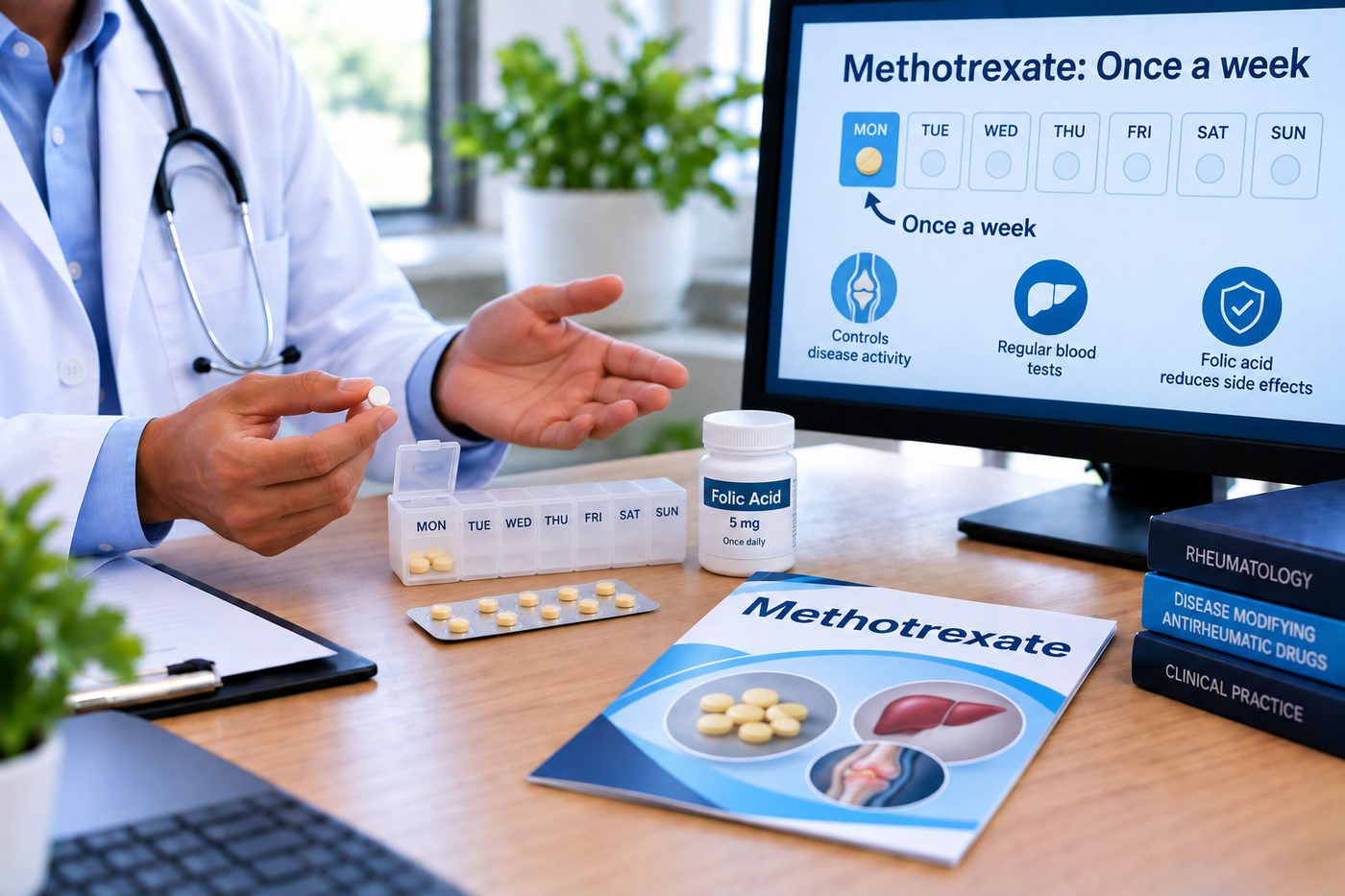
- Folic acid is taken alongside (on a different day) to reduce nausea, mouth ulcers and hair thinning. Don't skip it.
- Common early effects: nausea or tiredness the day after the dose, mouth ulcers. Usually mild and improve with time, folic acid, taking it at night, or switching to injections.
- Blood tests: every few weeks at first, then every 2–3 months — liver, kidney and blood counts. This is routine, not a sign of danger.
- Alcohol: keep it minimal. It multiplies the liver load.
- Injections vs tablets: weekly self-injection often works better and causes less nausea than tablets, especially at higher doses. It's worth asking about.
- Other medicines: tell any doctor you're on methotrexate. Certain antibiotics (like co-trimoxazole) and some other drugs interact.
Pregnancy and fertility — read this before conceiving
Methotrexate must be stopped before pregnancy — it can cause miscarriage and birth defects. Stop at least 3 months before trying to conceive, and use reliable contraception while taking it. It is also not used during breastfeeding. For men, guidance has become more relaxed in recent years, but discuss it before planning. Tell your rheumatologist as soon as you're thinking about a family — the disease will be controlled with pregnancy-safe alternatives.
Common questions
Is methotrexate safe long term?+
Can I drink alcohol on methotrexate?+
What if I miss my weekly dose?+
Why do I feel sick the day after methotrexate?+
Do I need to take methotrexate if I'm starting a biologic?+
Worried about methotrexate, or struggling with it?
Most problems are fixable with a dose change, folic acid, or a switch to injections. Come and discuss it — walk-in, no appointment.
Clinic timings & location